
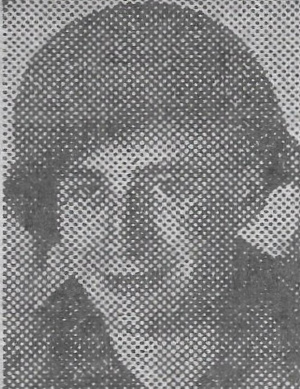
Paul Nicholas Fischer
Of the thirty boys who graduated with the Mineral Point High School Class of 1942, during World War II, twenty-two would eventually join or be drafted into the US military. Three would be Killed in Action. Paul Nicholas Fischer was one of those who died during that war from the Class of 1942.
In February of 1943, three Mineral Point men received their draft notices at the same time to report for duty with the US Army: Bruno Galle, Robert Jungbluth and Paul Fischer. They all reported to Camp Roberts, California for boot camp and infantry training. At the end of infantry training, Paul was separated from his unit when he suffered an appendicitis attack that required surgery. It was the last time Bruno and Robert would see him as he departed back to Mineral Point on a thirty-day medical furlough to recuperate. In December of 1943, Paul received orders to report to Camp White, Oregon for additional infantry training. In April of 1944, he was shipped to North Africa and joined Company K of the 361st Infantry Regiment of the 91st Infantry Division who fought in the Italian Campaign.
The 361st Infantry Division was involved in the capture of Rome, Italy in early June, 1944. From there they moved north and were successful at being the first Regiment of the US Army to reach the Arno River which flows through the Italian cities of Florence and Pisa. On June 25, 1944, at 7:30 PM, PFC Fischer and S/Sgt Rhuel Hays were leading a patrol advancing up a hill towards the small town of Scalvia, Italy. S/Sgt Hayes activated a land mine and was killed instantly. At that time, Fischer was about 50 to 60 feet to the left of Hayes. After the explosion, other members of the patrol called out for Fischer but he did not answer. Soldiers were sent to look for Fischer but they did not find him. S/Sgt Hayes was buried in a shallow grave near the spot where he was killed. His grave was marked with a stick holding his helmet on top of it . Fischer was listed as Missing in Action and presumed to have been taken as a prisoner-of-war by the German Army.
It wasn’t until almost two months later, on August 15, 1944, that the unburied remains of PFC Fischer were mysteriously discovered alongside the helmet-marked, shallow grave of his squad leader, S/Sgt Hayes, by members of the US Army’s 92nd Combat Engineer Battalion, who were later patrolling the same area near the town of Scalvia. A search of the unburied soldier’s remains next to S/Sgt Hayes was (believed to be) that of PFC Fischer from identification marks on his clothing, an address book, a small pocket bible, a letter from home and a ring that he wore. Because of the decomposition of both bodies, neither tooth chart or fingerprints were available. Both bodies were removed and reburied in the FOLLINCIA Military Cemetery south of Florence, Italy.
In July of 1949, PFC Fischer’s body was disinterred from the Follincia Military Cemetery and returned to Mineral Point. His remains arrived at the train station on July 5th. The American Legion, with Commander Robert Hannah in charge, along with many Legion members in uniform, firing squad and local residents escorted the body to the Fischer resident on Seventh Street. World War II veterans (his brothers Vincent and Donald, Bruno Galle, Robert Jungbluth, Pete Eckstein, Merle Bliss and others) in full military uniforms stood watch over Fischer’s casket each taking four-hour shifts, for the next two days. Services were held at the home on July 7th, at 8:00 AM and at St. Mary’s Catholic Church, at 9:00 AM, with Fr. Anthony J Herrmann officiating. Burial was at St. Mary’s Cemetery. Military rites were accorded by the Mineral Point American Legion’s Homer and Lee Parkinson Post 170.
FREEDOM IS NEVER FREE!
This article was put together using historical family documents presented to the Veterans of Foreign Wars Post 7629 Auxiliary in conjunction with the Avenue of Flags Project. Special thanks to Shirley Chambers and Larry Regan for preparing this article.